
UNHCR Georgia’s Office Relocation from 1st January
In connection with the office relocation, from 22 December to 13 January, individuals seeking consultations may approach our partner World Vision’s office, located at 67b Zhiuli Shartava Street. During this period, UNHCR can also be reached through the hotline and email indicated below:

Phone: +995 (0322) 185 123
Email: [email protected]
From 13 January onwards, UNHCR will resume consultations at the new office on Tengiz Abuladze Street, as usual, between 9:30 and 17:00.
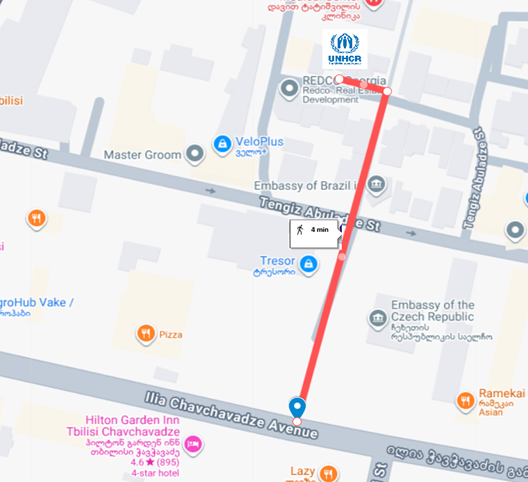
How to reach UNHCR’s new office
Public transport: Several bus routes serve the surrounding area (including 531, 345, 540, 311, 354, 359, 351, 301, 512, 540, 383, 307, 345, 309, 388). Use the Google Maps link above for step-by-step instructions from your location. You can also use the map below to see a simple route from Chavchavadze Avenue’s closest bus stop to 25 Tengiz Abuladze Street.
The UN Refugee Agency established a presence in Georgia in 1993. In 1999, Georgia ratified the 1951 Convention relating to the status of refugees and its 1967 Protocol. On 1 December 2016 Georgia adopted the Law on International Protection” that entered into force on 1 February 2017. The law brought the national legislation closer in line to the international standards. In 2011, Georgia acceded to the 1954 UN Convention relating to the Status of Stateless Persons.
The role of UNHCR in Georgia is to support and assist the Government in continuously enhancing the quality of refugee status determination procedure, promoting amendments to further align the legislation governing refugee/stateless issues with international standards and to monitor the implementation of the country’s international responsibilities relating to the protection of refugees and stateless individuals.
The main activities of UNHCR include:
- Advocacy for an effective asylum system and legislation in line with international standards
- Ensuring protection for all persons of concern
- Promoting self-sufficiency and local integration
- Creating humanitarian space for internally displaced and asylum-seekers in the context of mixed migration movements
- Combating and preventing statelessness
- Providing assistance to the most vulnerable refugees, humanitarian status holders and asylum-seekers
- Training government officials and civil society organisations involved in refugee and IDP protection, reduction of statelessness
- Advocacy activities aimed at enhancing refugee protection, and combating racism and xenophobia