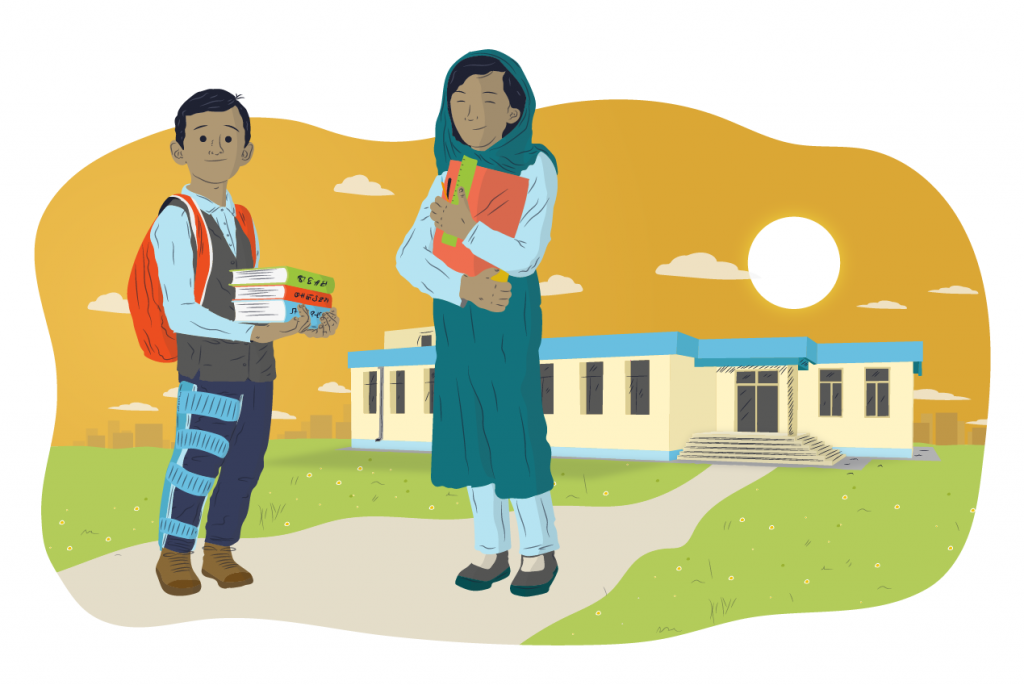
Are you under 18? If you are, this page is for you! You will find information about services for children and young people who have had to leave their home country and are now in Bangladesh.
I’m under 18, am I allowed to contact UNHCR?
Yes, you are! If you need information or support from UNHCR, you can contact us by email or through a helpline. It’s a good idea to talk to your parents or a trusted adult first, but you can also contact us on your own. Make sure you tell us your name, age, and your phone /WhatsApp number or email address @, or any other way to get in touch with you. It’s also a good idea to tell us the names of your parents if they are in Bangladesh with you. If you are not with your parents, you can also tell us that.
Can UNHCR Bangladesh or another organization help me if I am under 18?
Yes! UNHCR works with organisations that help girls and boys under 18 living in Ukhiya, Teknaf and Bhasan Char refugee camps. If someone has hurt you, or you are afraid they will, you can also call this number: 16670
Some organizations also have fun activities for children and young people and have counsellors you can talk to if you have a problem. Look for Child-Friendly Spaces or Multi-Purpose Centres for Children and Adolescents in the camp!
I’m staying in Bangladesh without my parents. Can UNHCR help me find them or other people in my family?
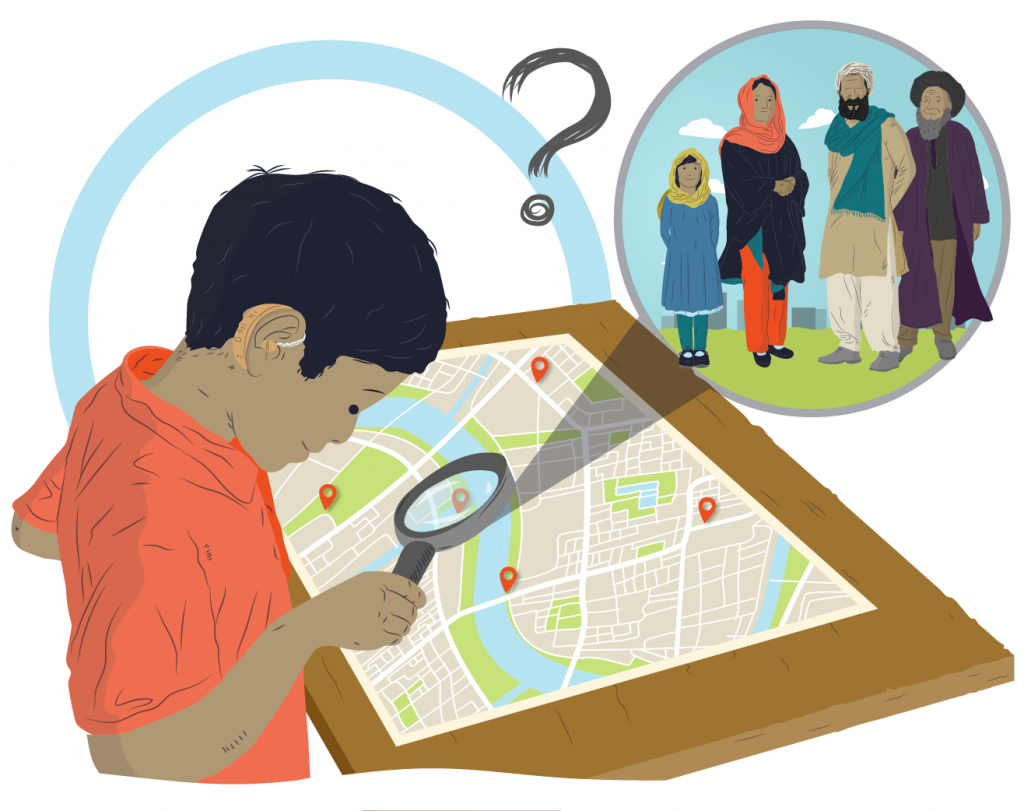
It’s not always easy or possible to find people who are missing or to get families back together, but children have a right to be with their parents and family. If you are not with your parents, it’s a good idea to let us know so that we can help you stay safe in Bangladesh. We can also try to help you find them and get in touch with them.
You can also reach out to the International Committee of the Red Cross and Bangladesh Red Crescent Society on:
I am not going to school right now, but I would like to. How can I get help to go to school?
Every child has a right to go to school. You do not need any documents ❌ and you do not have to pay extra ❌. UNHCR Bangladesh helps children living in Ukhiya, Teknaf and Bhasan Char refugee camps to go to primary school.
Get a parent or adult to help you, and visit our Education page.
UNHCR is responsible for implementing education programs at Kutupalong RC, Nyapara RC, and the Transit center for children aged 3-18 years, as well as lifelong learning for adolescents and youth aged 16-24 years across the UNHCR AoR camps.
In addition, there are some opportunities available for the third-country education pathways program for bachelor’s and master’s degrees.
UNHCR and partners provide education services for refugees in Cox’s Bazar and Bhasan Char camps free of charge.
Available Services:
Basic education using the Myanmar Curriculum from grades 1 to 5 at the transit center.
Formal education using the Pearson Edexcel Curriculum in ECE and KG to grade 8 at Kutupalong and Nyapara RC
Life-long learning (6 months long, Languages, Images, and Analytical Thinking -LIT) program for adolescents and youth aged 16-24 who have lower secondary level education.
Bridging Program (12-month program also known as Refugee Higher Education Access program- RhEAP) for adolescents and youth aged 17-24 who have a minimum grade 9 level of competencies.
Minimum scales of complementary education pathways to pursue a bachelor’s degree and a master’s degree in the Philippines, Canada, and Japan.
There are four possible options depending on the age and academic background of your child:
If your child is between 3 and 4 years old, s/he can enroll in Early Childhood Education (ECE). You can approach the nearest ECE center and meet with the facilitator or school supervisor.
If your child (new arrival) is 5 years old, s/he can enroll in Kindergarten (KG). You can approach the nearest Learning Centre (LC) and meet with teachers or the school supervisor. For the registered refugees, the age group will be 5-6 years, and they need to approach the nearest school.
If your child (new arrival) is between 6 and 14 years old and has never attended secondary grades, s/he can enroll in primary education while in registered camps, the age group will be 7- 12. Please approach the nearest LC or school.
Overaged children aged 11+ with a lack of age and grade-appropriate competency will attend accelerated learning programs. You can approach the nearest Learning Centre.
Please visit a nearby school/LC and meet with the school supervisor/Head teacher/assistant teacher.
You can also get more information about the secondary school/LC from the LC where your child completed primary education. Your child may need to attend a placement test to enroll in secondary classes.
Beyond secondary education, there are two possible opportunities available, depending on age and previous academic background:
Language, Images, and Analytical Thinking (LIT): Youth/adolescents (Aged 16-24 years) with basic literacy and numeracy skills and potentially Lower-secondary education completion (up to grade 7) are eligible to enroll for this course. The learner will receive six months of education focused on acquiring English language skills, imaginative thinking, analytical skills, and digital literacy skills. After completing this upskilling program, the learner will be eligible to enroll in the Bridging program or skills training.
Bridging Program: Youth/adolescents (aged 17-24) who have completed LIT or completed up to grade 9 will be eligible to enroll for this higher education access program (RhEAP) comprising different subject areas. This 12-month course is a bridging program that paves the pathway for learners to pursue their university-level education in the future.
Your child will require:
A refugee ID
Any previous school certificates/transcripts could be helpful, so please bring them for enrolment.
For higher education institutions already offering scholarships, UNHCR maintains the Opportunities site, a scholarship which includes many scholarship opportunities to study in countries that meet basic refugee protection standardsand access to international protection.
In Bangladesh, we have a JICA scholarship program for the master’s degree program for a limited number of students. The students aged 22-39, who have completed their graduation and have original certificates and transcripts, are eligible to apply. Additionally, scholarships for a bachelor’s degree are available in the Philippines and Canada, but these are limited. Students must present their HSC/RhEAP education completion certificates and transcripts to obtain this scholarship.
In the first quarter of the year, the information about the scholarship program is usually disseminated by COMS, and after that, the education team communicates with the potential students.
Additionally, students who ask for a scholarship opportunity through CAIPP are enlisted as potential candidates and are contacted when there is an opportunity.
If you are interested in enrolling in any of these programmes, approach your nearest learning centre for more information, or go to one of the Information, Complaints and Feedback points.