
Year: 2026

Information about UNHCR biometric data deletion

    If you enrolled in the UNHCR cash assistance programme in Poland between 2022 and 2024, please be informed that your biometric data (i.e. fingerprints), which was collected for identity verification purposes has now been deleted.

    You will find more information on this page. 

    Your biometric data may have been retained by UNHCR only in the rare situation when:

    • You have subsequently moved to another country, and
    • You enrolled/registered with UNHCR in that country where the Biometric Identity Management System (BIMS) is in use.

    Your biographical data and assistance records related to past cash assistance or other UNHCR activities in Poland are retained only for audit, accountability, and archival purposes, in line with UNHCR retention standards and our Policy on Data Protection and Privacy (2022) and our Policy on the Protection of Personal Data of Persons of Concern to UNHCR (2015).

    For more information on how UNHCR in Poland uses the personal data collected from you and your rights relating to the use of your personal data, please see our privacy notice.

    Why did UNHCR delete biometric data of refugees from Ukraine?

    UNHCR cares about data protection and your right to privacy. 

    We deleted your biometric data in line with our Policy on Data Protection and Privacy. This policy sets a high standard of personal data protection similar to international data protection frameworks, including those applied in the EU. According to this policy, UNHCR must delete your personal data when it no longer needs it for a specific purpose.

    Since UNHCR’s financial assistance programmes for refugees from Ukraine in Poland ended, there is no longer any reason for UNHCR to keep your biometric data.

    UNHCR Poland has therefore deleted this data in order to discharge its duty and to protect your privacy.

    UNHCR’s cash programme ended in March 2024. Why is UNHCR only deleting this data now?

    UNHCR manages the personal data of refugees in line with our Policy on Data Protection and Privacy, which is consistent with international and EU data protection standards. We may keep your biometric data for a limited time after a program has ended for auditing and accountability purposes. Protecting your privacy and safety remains our top priority.

    Will the deletion of my data impact my legal status, rights or entitlements in Poland?

    No, it will not affect your legal status, rights and entitlements.

    The state authorities in Poland are responsible for registering and granting legal status to  refugees from Ukraine present in their territory. Therefore, the deletion of your biometric data collected and held by UNHCR will not have any impact on your legal status and rights.

    It will also not affect other services that UNHCR or partners provide to refugees in Poland, for which biometric data is not needed.

    Is UNHCR deleting all personal data of refugees from Ukraine? If not, why is UNHCR keeping (retaining) some of the refugees’ data if it does not need it any longer?

    Biometric records of refugees who were previously enrolled in Poland, and whose last recorded contact with UNHCR was in Poland were deleted.

    UNHCR continues to retain biometric records of refugees who, despite their initial enrollment in Poland, have most recently enrolled with UNHCR in another country where UNHCR’s BIMS system is used. This is because their biometric records are still needed in order to provide them with protection and/or assistance in those other countries. UNHCR will continue to retain other personal data of refugees previously enrolled in Poland, including biographical data and personal data related to assistance provided to them. This is for the purposes of auditing and archiving.

    Can I request confirmation of the deletion of my biometric data?

    Confirmation of the deletion of your biometric data is issued only upon request. Such requests should be submitted by email and must include:

    • Your full name,
    • Date of birth,
    • PESEL-UKR number or Ukrainian Tax ID number. 

    Your other rights are explained in detail on this page.

    Should you have any concerns, questions or complaints regarding the processing of your personal data by UNHCR, you can contact UNHCR Poland via UNHCR’s helpline by clicking the button below.
    Germany changes rules for Temporary Protection

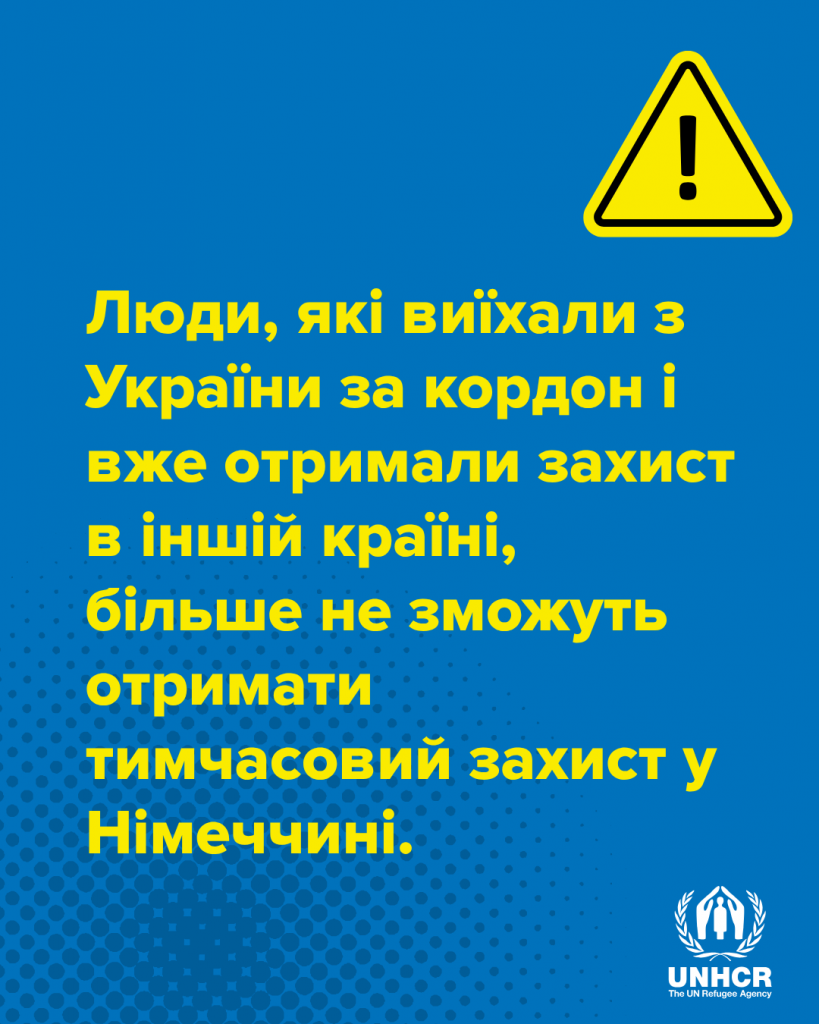
      ⚠️ Germany changes rules for Temporary Protection! (See the infographic below 👇)

      If you have already obtained temporary protection in another country, Germany will no longer grant you this status.

      Please advise individuals considering onward movement to seek advice from our legal partners prior. 

      List of the legal partners in Poland- https://help.unhcr.org/poland/helpful-services/countrywide-services-and-helplines/

      ℹ️ Info for NGOs and Volunteers: Please share this update during consultations to help refugees avoid rejections or being turned back at the border.

      If you have already obtained temporary protection in another country, Germany will no longer grant you this status.

      Important Legal Changes from 4 March 2026 for refugees from Ukraine

        The legal rules that apply to refugees from Ukraine in Poland will change from 4 March 2026 onwards.

        These changes mean that temporary protection (PESEL-UKR) will now be based on a different set of laws – the Act on Granting Protection to Foreigners within the Territory of the Republic of Poland instead of the previous Special Act.

        You may have some concerns about these changes.

        It is important to be informed of the most important changes may impact your daily life, including accommodation, healthcare and social services.

        Below we explain what this means for you and who to reach out to for further information tailored to your individual situation.

        Will I lose my legal stay?

        No, you will not automatically lose your legal stay. If you have PESEL UKR, it remains valid and your stay remains legal until 4 March 2027.

        However– if you registered for PESEL UKR on the basis of a declaration only, you will need to acquire and present a valid travel document before 31 August 2026 at the nearest urzad gminy (click here for more information on how to extend your travel document). Please note: this is especially important for children under the age of 18 who were previously verified based on photographs attached to the parent(s)/guardian’s passports.

        Do I need to do anything?

        • You do not need to leave Poland or apply for a different legal status.
        • You do not lose your legal status.

        However– if you registered for PESEL UKR on the basis of a declaration only (without presenting a valid travel document) you will need to acquire and present a valid travel document before 31 August 2026 at the nearest urzad gminy (click here for more information on how to extend your travel document). Please note: this is especially important for children under the age of 18 who were previously verified based on photographs attached to the parent(s)/guardian’s passports.

        If you arrived in Poland after 4 March 2026 you will need to register for PESEL UKR within 30 days of arriving in Poland (click here for information on how to register for PESEL UKR).

        You may also need to take some active steps when it comes to access to public healthcare and ensuring you are insured via the National Health Fund (NFZ). Click here for more information.  See more information on healthcare access and eligibility below.

        You may also need to take active steps to secure accommodation before 30 June 2026 if you are currently living in a collective accommodation facility as a single parent caring for three or more children.

        Will I still be able to access services?

        Yes, but some important changes will be introduced. You can find some of the most important ones for you here:

        From 5 March 2026 onwards

        You will need to be insured through NFZ to access healthcare. Please click here for more information.

        Nothing will change if you are still allowed to live in a collective site, or you are pregnant, in labour or post-partum, if you are below 18 or a survivor of torture or violence, or if you were injured because of the war.

        Emergency healthcare, for example, as a result of an accident, is always available.

        From 5 March 2026 onwards

        You will have limited access to social services provided by MOPS/GOPS/OPS

        You are entitled to shelter, meals, essential clothing, targeted allowance only.

        From 5 March 2026 onwards

        Nothing will change for citizens of Ukraine who hold PESEL UKR when it comes to working or opening a business in Poland.

        Ukrainians who stay legally in Poland without PESEL UKR status can work without extra permits for the next 3 years. Nothing will change if you opened a business before 4 March 2026, from 5 March 2026 more rules will apply (general rules for foreigners opening a business in Poland will apply).

        From 5 March 2026 onwards

        Nothing will change when it comes to benefits like the Child Raising Benefit (800+) and Dobry Start (300+).

        The same rules apply: you must be “professionally active” (click here for information on what this means exactly, NB: you do not need to work to be eligible) and your child(ren) must be enrolled and attending Polish school. 

        From 30 June 2026 onwards

        Single parents caring for three or more children will no longer be able to live in collective accommodation free of charge.

        If you hold UKR status, are unable to secure accommodation independently, and belong to a vulnerable group, i.e. if you:

        • have disabilities (severe or moderate),
        • are a man over the age of 65, are a woman over the age of 60 (if you do not receive a Polish pension, do not work, and do not have adult children in Poland who are legally required to support you),
        • are pregnant or caring for a child up to 12 months,
        • are a child in an international foster care facility
        • or are a previously hospitalised person,

        you will be able to continue residing in a collective site.

        Where can I find reliable information?

        Always check information from official or verified sources, such as:

        Where can I find help?

        We understand that legal changes can feel stressful.

        Please remember:

        • They are not meant to remove protection.
        • Reliable help and information are available.

        Your individual legal situation is unique, and consulting a lawyer to discuss it is important.

        The organisations listed below provide legal assistance free of charge and are experienced in supporting refugees from Ukraine in Poland:

        Stowarzyszenie Interwencji Prawnej

        (+48) 880 145 372 (Mon-Fri, between 15:00-16:00 to make an in-person appointment in Warsaw)

        Dedicated website for people arriving from Ukraine: ukraina.interwencjaprawna.pl

        Helsinki Foundation for Human Rights

        (+48) 789 065 118 (Mon-Fri, 14:00-17:00)

        Working hours: Mon-Fri, 14:00–17:00

        Right2Protection

        (+48) 530 944 568 (Monday to Friday from 10.00 to 16.00))

        Online form for making an appointment for an individual consultation

        Fundacja Ocalenie Foundation

        Fundacja Instytut na rzecz Państwa Prawa

        If you are in Lublin: ul. Chopina 14/70, Lublin

        (+48) 81 743 6800, (+48) 881 917 171, (+48) 884 006 774

        Working hours: Mon-Fri, 09:00-16:00

        Nomada

        If you are in Wroclaw: ul. Dubois 11-13, Wrocław

        (+48) 791 576 459 (English) (+48) 536 149 008 (Ukrainian and Russian)

        Working Hours: Mon.-Fri., 10:00-17:00

        Call UNHCR toll-free from your browser

        You are about to call UNHCR. If you are ready, please click next to allow microphone access when asked so we can hear you.

        Set your browser permissions

        Please give permission to access your microphone and geolocation when prompted by your browser. Sharing your location is optional, but enabling your microphone is required for UNHCR operator to hear you.

        Example microphone permissions prompt that will appear in your browser:
        Example microphone permissions prompt that will appear in your browser: Example

        Toll-free call to UNHCR

        Call UNHCR toll-free from your browser

        You are about to call UNHCR. If you are ready, please click next to allow microphone access when asked so we can hear you.

        Set your browser permissions

        Please give permission to access your microphone and geolocation when prompted by your browser. Sharing your location is optional, but enabling your microphone is required for UNHCR operator to hear you.

        Example microphone permissions prompt that will appear in your browser:
        Example microphone permissions prompt that will appear in your browser: Example

        Toll-free call to UNHCR