



Refugee participation
All UNHCR services are free!
On this page:
UNHCR’s Accountability to Affected People (AAP) is a commitment to include the views of refugees and asylum-seekers in the decisions that UNHCR makes. This is to ensure that UNHCR’s decisions, services and programmes truly meet the needs of refugees and asylum-seekers, and that UNHCR resources are used to achieve sustainable outcomes for refugees and asylum-seekers.
As part of UNHCR Malaysia’s commitment to AAP, UNHCR has initiated several mechanisms to engage with refugee communities from diverse backgrounds, to hear their challenges, opinions and receive feedback on UNHCR services and programmes. These mechanisms include:
- The Refugee Advisory Board
- Women for Women (W4W)
- Outreach Volunteers Programme
- Youth Network
- Communication with Communities (CwC) Working Group
Through these mechanisms, UNHCR aims to increase the meaningful participation of refugees in its activities; empowering refugees to be agents of their own protection. UNHCR also provides on-going training to refugees in order to increase their resilience, as well as their knowledge and skills to effectively advocate for issues affecting their protection.
REMINDER!
Please note that the Refugee Advisory Board members, Outreach Volunteers and the members of the above mechanisms:
- Do not represent UNHCR and have no authority to act on behalf of UNHCR.
- Have no authority to provide any UNHCR services to refugees.
- Have no authority to obtain faster or prioritized service for refugees.
Refugee Advisory Board
The Malaysia Refugee Advisory Board (RAB) was established in June 2023 at which time the board constituted its first pilot cohort. The Board is representative of the diverse refugee population in Malaysia, comprising experienced refugee leaders and community focal representatives from various age groups, nationalities, ethnicities, genders, and professional backgrounds. It serves as a unified voice for refugee communities, aiming to amplify and coordinate advocacy for all refugees in the country.
What do they do?
- Ensure the voices of refugees are considered in UNHCR’s decisions, services and programmes in Malaysia.
- Coordinate with all relevant stakeholders in projects and programs that benefit and build the capacity of refugee communities.
- Advocate with relevant stakeholders to address refugees’ basic needs and improve the overall protection environment of refugee communities in Malaysia.
Who are the board members?
The RAB’s current cohort consists of 17 members, appointed to serve as board members for the period January 2025 to December 2026. They were invited to serve after an open selection process, which involved UNHCR Malaysia, NGO partners, as well as previous refugee leaders who have already been resettled. The current cohort consists of refugee leaders from Myanmar, Afghanistan, Syria, Algeria, Somalia, Iran, Pakistan, etc.
Key activities and achievements of RAB Cohort 2
- As a key refugee advocacy structure, RAB continues to be a strong voice for refugees across multiple platforms such as in Refugee Health Stakeholder Coordination meeting in August 2025, meeting with EU delegations, meeting with Canada Prime Minister’s wife and meeting with UNHCR auditors.
- The RAB attended a series of advocacy training conducted by Malaysian Centre for Constituionalism and Human Rights (MCCHR) and further practice the knowledge and skills learned in engaging parliamentarians and various stakeholder during The Parliamentary Symposium on Access to Education and Legal Work for Refugees in February 2026.
The RAB Education Working Group works closely with education partner Fugee HiEd to advocate for improved access to tertiary education for refugees in Malaysia. This includes collaboration with local universities to explore collaborative opportunities.
The RAB plays a crucial role in representing and providing practical recommendations based on the lived experiences of the communities they represent. This includes engaging Allianz Malaysia in a consultation session to enhance equitable access to healthcare and engaging hard-to-reach refugee communities.
Women for Women (W4W)

Women for Women (W4W) network was established in 2023 to serve as a safe space for refugee women, ensuring women’s opinions are heard and considered in UNHCR’s decisions. W4W is comprised of women leaders and representatives from refugee-led groups, learning centres, volunteers from various nationalities and ethnicities. The platform also serves as a capacity development platform for refugee women so that they are equipped and empowered to provide support and assist their community members.
Main objectives:
- Promote awareness on women-related topics and concerns
- Platform for capacity development and self-improvement
- Facilitated cultural exchange and social activities
- Strengthening women’s engagement and increase women’s participation in refugee leadership structures
Past activities:
- Cultural sharing session
- Awareness session on family planning and cervical cancer
- Skill trainings such as Canva and Microsoft PowerPoint training
- Training on International Humanitarian Law, women’s rights, sexual offences against children and domestic violence
Outreach Volunteers Programme

The Outreach Volunteer Programme was established in 2022 with the primary objective of increasing access to information for asylum-seekers and refugees in Malaysia, especially those living outside Kuala Lumpur and Selangor. Refugee Outreach Volunteers are trained by UNHCR and play an active role in:
- Providing basic information on services and assistance following queries from their community members
- Supporting the community in accessing the UNHCR Malaysia Help site and its online features and forms
- Conducting information-sharing sessions with community members
There are 144 active Outreach Volunteers from various nationalities in Johor, Kedah, Kelantan, Kuala Lumpur, Melaka, Pahang, Penang, Perak, Selangor, and Terengganu.
2026 Q1 Community Leaders Townhall
UNHCR Malaysia held its first Community Leaders Townhall of 2026 on 12 March, bringing together forty leaders from different refugee communities to discuss key updates, including on registration and resettlement. For the first time, the Community‑Based Protection (CBP) team organised the session in a hybrid format, allowing community leaders in Johor and Penang to participate remotely with support from Cahaya Surya Bakti (CSB) and the Penang Refugee Network (PRN).
In the introductory remarks, the UNHCR Representative Louise Irene Aubin explained that since 2025, many services and solutions previously available to refugees have been reduced due to shrinking resources and the impact of continued global conflicts. She noted that UNHCR has had to make difficult decisions to ensure that essential services in Malaysia can continue. Louise also shared that in 2026, UNHCR will keep working closely with the Government on the Dokumen Pendaftaran Pelarian (DPP). She highlighted the positive momentum from the Parliamentary Symposium on refugee access to education and legal work, and the upcoming engagements with judges and religious scholars aimed at strengthening refugee protection through both legal and faith‑based perspectives.
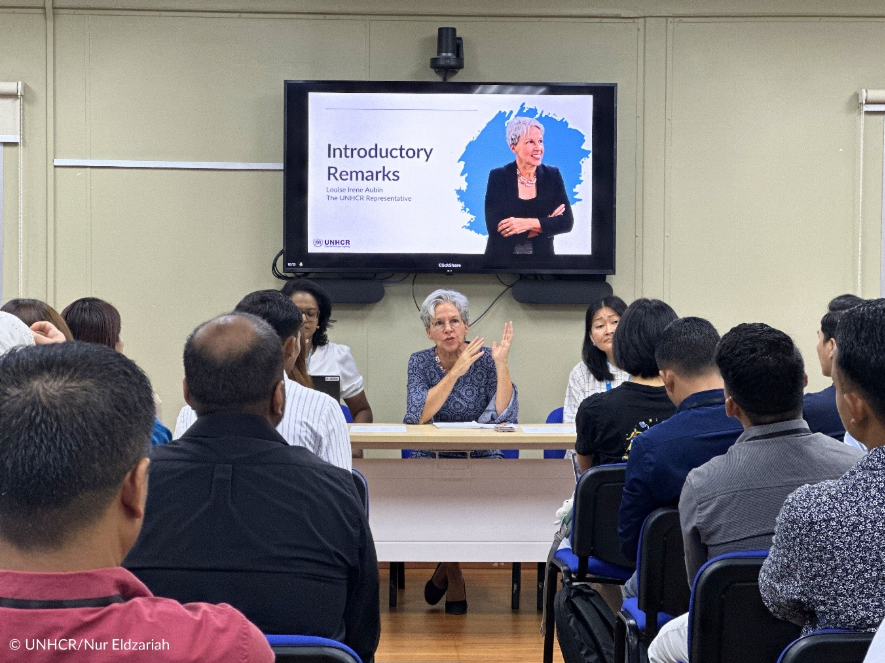
The Registration Unit presented its 2026 strategy and targets, addressing concerns raised by communities regarding registration delays, how appointments are allocated, long‑pending applications, the inclusion of family members/newborns and challenges linked to changing contact information. Community members were reminded to keep their contact details updated to improve communication. Leaders were also introduced to the upcoming Digital Gateway service and encouraged to raise awareness among their members about the importance of email use for future processes.
On resettlement, the Durable Solutions Unit clarified that resettlement is based solely on individual needs and protection risks, not on how long someone has lived in Malaysia. With global resettlement opportunities continuing to decline, communities were encouraged to explore complementary pathways such as education and sponsorship programmes in countries like Australia and Canada. Community leaders were reminded to guide their members to contact embassies directly for information on these options.
Community-Based Protection (CBP) colleagues also shared that funding for NGO partners remains limited, although essential protection services continue for children at risk, survivors of gender‑based violence and other vulnerable individuals. CBP has issued warnings to certain community groups involved in harmful practices and noted that stronger enforcement will be a priority in the coming year. Communities also raised concerns about access to healthcare and the risks faced by individuals who are repeatedly arrested. UNHCR continues to follow up on these issues with relevant authorities and encourages leaders to share specific cases to support advocacy efforts.
Throughout the session, UNHCR emphasised the importance of continued collaboration and communication with community leaders to strengthen refugee protection in Malaysia. Feedback received from the attendees showed that more than ninety percent of participants found the information shared by the Registration and Resettlement unit very helpful in clarifying the concerns raised by their communities.
To report fraud and corruption conducted by refugees or asylum-seekers, please visit Contact Us page.