

FAQ on work and income
The Ministry of Labor and Social Security, through the Undersecretariat for Labor Inspection (SIT), in partnership with the International Labor Organization (ILO), the International Organization for Migration (IOM) and the United Nations High Commissioner for Refugees (UNHCR), developed the Protect Work website, with important information for migrants and refugees about work and employment.
There are several booklets with information on Slave Labor, Child Labor, Domestic Work, Temporary Work, among others.
With your Individual Taxpayer Registry (CPF) in hand, you can issue a Work and Social Security Card (CTPS). This is the same document that Brazilians have. The CTPS is granted on a definitive basis, with no expiration date. More information about documents.
Brazilian labor rights must be respected regardless of the employee’s nationality. Note that employment rights include, but are not limited to:
- Maximum working hours of 12 hours a day and 44 hours a week;
- Employment Card signed by the employer;
- Compulsory paid leave;
- 13th salary, in addition to twelve payments during the twelve months of the year;
- Right to a monthly minimum wage (R$ 1.412,00 if you work 44 hours a week) or proportional payment;
- One day of weekly paid rest, preferably on Sundays;
Important! If you suspect that your employment rights are being violated, seek legal assistance.
Yes. Furthermore, women have certain specific rights, such as:
- 120 days of maternity leave
- Women cannot be fired for being pregnant.
- Pregnant women have the right to leave work to visit a doctor
- A woman cannot be unfairly dismissed for five months after giving birth
Important! If you suspect that your employment rights are being violated, seek legal assistance.
No. Children under the age of 14 cannot work in Brazil. Children over 14 years old can work under special conditions:
- Maximum 6 hours of work per day
- The employee is obliged to allow time for the children to go to school
- Right to take holidays from work simultaneously with school holidays
- Children cannot work in hazardous conditions
- Children cannot work at night.
Important! If you suspect that your employment rights are being violated, seek legal assistance.
In Brazil, workers who work 44 hours a week or more cannot be paid less than the national minimum wage. The minimum wage stipulated by the federal government is R$ 1.412,00 and may vary more depending on the state.
Important! If you suspect that your employment rights are being violated, seek legal assistance.
Yes. eSocial is a system where employers communicate with the Government, passing on information related to workers. Through this electronic transmission of information, the bureaucracy of tax, social security and labor obligations is reduced; in addition, it is a way of guaranteeing that the social security and labor rights of workers are guaranteed.
To admit a refugee worker, it is not necessary to have a National Migration Registration Card (CRNM), Provisional National Migration Registration Document (DPRNM), it is enough that the person has the CPF and the Social Identification Number (NIS) (PIS, PASEP or NIT).
To learn more, visit the Federal Government website.
Most companies require a basic level of Portuguese to hire you. More information about Portuguese courses.
In Brazil, self-employed persons may register as individual microentrepreneurs, known as MEI, if their business income does not exceed R$ 81,000.00 per year.
To qualify, one must not be a partner or owner of another company. One may have only one employee, who must receive at least the minimum wage or the minimum wage applicable to that professional category. MEIs are exempt from certain federal taxes.
Before registering, one must check the Federal Government website to see whether the activity intended to be carried out is included in the list of activities allowed for MEIs.
Registration can then be completed through the Portal do Empreendedor. One must indicate their country of origin and provide the number of one of the following documents: Asylum Protocol (Protocolo de Refúgio), Provisional National Migration Registration Document (DPRNM) or National Migration Registration Card (CRNM).
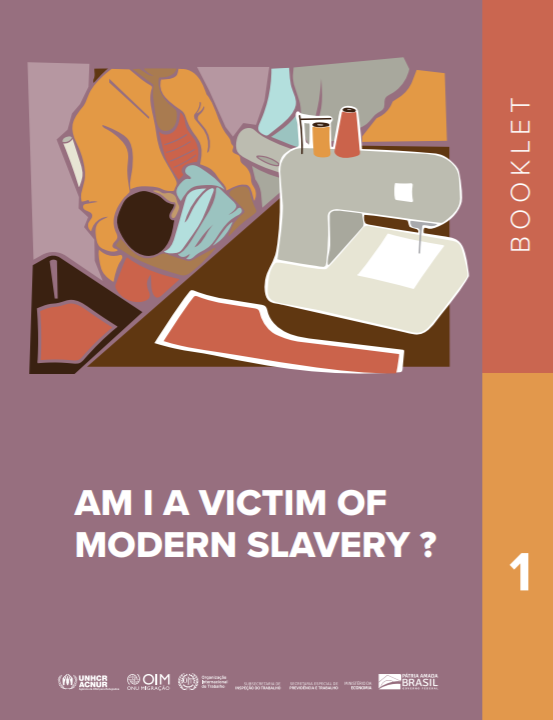
To see the complete booklet, click on the image below.