Are you under 18? Did you have to leave your home country?
Have you just arrived to Switzerland?
On this page, you will find information that is easy for children to understand. This information can help you to answer your questions.
*Icons used on this page contain images by Muhammad Afandi on Unsplash and Madhana Gopal from Pixabay.
I cannot go home and want to stay in Switzerland. What do I have to do?
If it is not safe for you to return to your country and you want to stay in Switzerland, you can apply for “asylum”. You should do this as soon as possible. This way, Switzerland can support you.

You can apply for asylum at all Federal Asylum Centres in Switzerland. A Federal Asylum Centre is a place where people can apply for asylum and receive food, clothes and medical support, as needed. If you are already in Switzerland, you can go to the Federal Asylum Centre directly.

If you arrive in Switzerland by plane, you can ask for asylum directly at the airport (Geneva or Zurich). Everybody who works at the airport can tell you where you need to go. You will be assigned a person of trust who can answer your questions.
If you are stopped by the border police at the land border or in Switzerland, you can also tell them that you want to apply for asylum. They will help you to get to a Federal Asylum Centre.
Where can I sleep, eat and shower?

In a Federal Asylum Centre, people who have asked for asylum will be given a place to sleep, food and drink. If you came to Switzerland with your parents, you may share a room with them and another family. If you came to Switzerland on your own, you might share a room with other children. You can find more information on how to get to a Federal Asylum Centre in the next sections.
Where are the Federal Asylum Centres and how do I get there?
There are 6 Federal Asylum Centres in Switzerland. You can go to the Centre that is nearest to where you are.
The colourful pins on the map show you the location of the 6 Federal Asylum Centres in Switzerland.
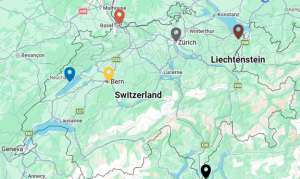
Here are the contact details of the 6 Federal Asylum Centres:
 Federal Asylum Centre Boudry:
- Address: Rue de l’Hôpital 60, 2017 Boudry
- Telephone number: 0041 58 465 03 03
 Federal Asylum Centre Bern:
- Address: Morillonstrasse 75, 3007 Bern
- Telephone number: 0041 58 461 44 20
 Federal Asylum Centre Basel:
- Address: Freiburgerstrasse 50, 4057 Basel
- Telephone number: 0041 58 482 12 82
 Federal Asylum Centre Chiasso:
- Address: Via Milano 23, 6830 Chiasso
- Telephone number: 0041 58 466 70 10
 Federal Asylum Centre Zurich:
- Address: Duttweilerstrasse 11, 8005 Zürich
- Telephone number: 0041 58 480 14 80
 Federal Asylum Centre Altstätten:
- Address: Schöntalstrasse 2, 9450 Altstätten
- Telephone number: 0041 58 480 49 50
The Federal Asylum Centres are called differently in different languages. When you are on your way to the Centre, you may find signs with these words on them:
- In German, Federal Asylum Centre is called Bundesasylzentrum (= BAZ).
- In French, it is called Centre fédéral d’asile (= CFA).
- In Italian, it is called Centro federale d’asilo (= CFA).
Depending on where you are, you can go to the Federal Asylum Centre by foot, by bus or by train. If you have never taken the train before and want to find out how it works, you can find an explanation below.
If you have a problem finding the Centre, you can call them and ask how to get there. If the police stops you on your way to the Federal Asylum Centre, tell them that you want to apply for asylum. The police can help you to get to the Centre.
If you are in Geneva, you can also go to an office called “Service de protection des mineurs (SPMi)“. This office is responsible for anyone under the age of 18. They will give you a train ticket. You can use it to travel to the Federal Asylum Centre Boudry.
The SPMi has the following address: Rte des Jeunes 1E, 1227 Les Acacias.
The office is open in the morning from 8:00 am until 12:30 pm. During lunch time, it is closed. In the afternoon, it is open from 1:30 pm until 5:00 pm.
How do I take the train?

First, you need to buy a ticket. You can buy tickets at the train station. You can find out how to buy a ticket at the vending machine here: How to buy a ticket at the vending machine.
After you buy a train ticket, you can check here when the trains depart. On that website, you enter where you are (= From) and where you want to go (= To).
Example:
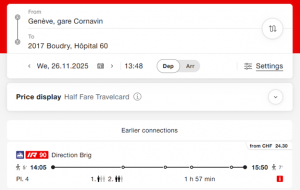
The time on the left side shows when the train departs. The time on the right side tells you when you will arrive at your destination.
The name mentioned together with “Direction” (on the photo “Brig”) is the name of the last stop of the train.
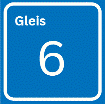
“Pl.” means “Platform”. This means the platform from which the train will depart at the train station. All platforms have signs like this one that show their number:
Depending on where you start from, you may have to change trains. This means that you need to change from one train to another train, or from a train to a bus. When you must change trains, the itinerary of your trip will say “transfer”. When you search for a train on the internet, the itinerary might look like this:
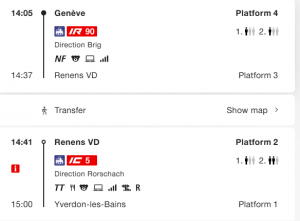
The blue train symbol  means that you need to take a train. When you need to take a bus, the symbol in the schedule looks like this:
  .
.
When you need to change trains, remember to be at the new platform or bus stop on time. If you have trouble finding the new platform or bus stop, or do not know if you need to change trains, you can always ask the ticket collector on the train or the people who work at the train station.
What can I do when someone has done something that made me uncomfortable? Who can help me when I have lost important things?
It is important that you always stay safe. When you leave your accommodation, tell a friend where you are going. Only follow people that you know and trust. If something happens to you that does not feel right, it is important that you talk about this with a person that you trust. When you live in a Centre, you can always talk to the people who work there. They are there to protect and support you.
When someone does something to you that does not feel right, you can call the police. In Switzerland, the police are responsible for protecting you. The police officers can help you with your problem. The police can also help you when you have lost something important, like your passport.
To call the police, enter 117 on the telephone and press the call button. You can also go directly to the police station that is closest to you.

In Switzerland, nobody is allowed to force you to marry a person that you do not want to marry. You must be at least 18 years old to get married in Switzerland. If you have been told that you will get married in Switzerland, but you do not want to, you can call the organization Service against Forced Marriage. They will listen to you and find a way to help you. Your conversation with them is confidential. That means that they are not allowed to tell others about the conversation, not even your parents or other relatives, unless you want them to. You do not have to pay for calling the organization.
To call the Service against Forced Marriage, enter 0800 800 007 on a telephone and press the call button.
I feel sick. What can I do?
- Is it an emergency?
If you need medical care immediately, please contact the medical service of the center. Outside of the center, call the emergency number as soon as possible. You need urgent medical care when you are very sick or injured. For example, you need urgent medical care when you are bleeding heavily.
To call the emergency number, you can enter 144 on any phone and press the call button.
- Is it not an emergency?

When you feel sick, you can receive medical care in a Federal Asylum Centre. There, you can go to the Medic-Help. They will listen to you and, if necessary, send you to a doctor.
If you are living in a Cantonal Centre, you can say that you would like to speak to a “person responsible for health”.
Where can I get Internet access?

At the major train stations and some supermarkets, you can register with an SMS code to get Wi-Fi access in those locations. You will need a cell phone with a SIM card.
If you live in a Centre, you can ask for Internet access there.
I feel sad, angry or lonely. Who can help me?

Are you afraid because you don’t know if you can stay in Switzerland? Has someone treated you badly? Do you want to tell someone about it?
If you are in a Federal Asylum Centre, you can go and see the medical team who works there. You can tell them how you feel and say that you need help. They will see if it would be good to talk to a psychologist. Psychologists know a lot about different feelings. They can give you tips and are happy to listen to you. When you talk to a doctor or psychologist, this conversation is confidential. This means that they are not allowed to talk about your conversation with another person, not even with your family members, unless you want them to.
If you do not want to talk to a doctor, there are also organizations that you can talk to:
- Pro Juventute is an organization that only works for children and young people, and they are there to listen to you and to support you.
- To call Pro Juventute, you can enter 147 on your phone and press the call button. Calling Pro Juventute is free of charge, which means that you do not need to pay for it.
- You can also write to them on WhatsApp (0041 800 147 000) or send them an email to [email protected].
- 143.ch is an organization that you can call when you feel unhappy and want to talk to someone. They are there to listen and to support you.
- To call 143.ch, you can enter 0800 143 000 on your phone and press the call button. Calling 143.ch is free of charge, which means that you do not need to pay for it.
Your conversation with these organizations is confidential. That means that they are not allowed to tell others about the conversation, not even your family members, unless you want them to.
When you experience bad feelings, remember that you are not alone. You can always talk to the staff at the Centre where you live and ask them for support.
What happens after I applied for asylum?

When you apply for asylum, your asylum procedure begins. This means that the Swiss authorities will examine your situation closely and then decide whether you can stay in Switzerland. In the asylum procedure, you usually have an interview. In the interview, you will be asked many questions. Maybe you will also be asked to show some documents or pictures. This will help the Swiss authorities to understand your situation.
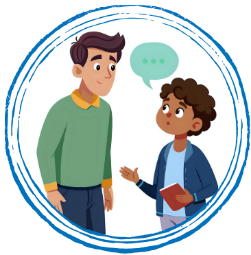
During the asylum procedure, there will be a legal representative to help you. Your legal representative is a person who studied law and knows the asylum procedure in Switzerland. The legal representative is also known as a “person of trust”. This person will support you throughout the entire process. You do not have to pay for this. It is free of charge.
During the asylum procedure, you may need to move to another Centre. If this is the case, somebody will tell you before, so that you can prepare. You will have a legal representative also at the new Centre.
For some people, the asylum procedure lasts only a very short time. For others, it lasts longer.
At the end of the asylum procedure, you will receive a decision. It informs you if you can stay in Switzerland or need to return to your home country. It also informs you on your rights and duties if you can stay in Switzerland. Your legal representative can explain the decision to you. If you think that the decision is wrong, you have a right to appeal. This means that you can ask a court in Switzerland to check the decision. If you want to appeal your decision, you need to talk to your legal representative.
If your decision says that you can stay in Switzerland, you will move to one of the Swiss cantons to live there. If you came to Switzerland on your own, you will receive a place to stay. If you are under 16 years old, you must also go to school.
I have more questions. Who can answer them?
If you have more questions about the asylum procedure, you can have a look at the UNICEF leaflet: Your rights in the asylum process.
You can also contact the Children’s Ombuds Office. They can answer your questions and explain many things to you. Their help is free and confidential. This means that you do not have to pay them, and that other people will not find out about the conversation if you don’t want them to.
For example, you could ask the Children’s Ombuds Office: What am I allowed to do here in Switzerland? What am I not allowed to do? How should adults treat me? If I need any help, who do I contact?
To contact the Children’s Ombuds Office, you can enter 0041 52 260 15 55 on your phone and press the call button. You can call the Office from Monday to Friday, from 8:00 am in the morning to 5:30 pm in the evening. You can also send the Office an email to [email protected].
Remember that you can also always ask your legal representative and the persons working at the Centre where you stay.
I have lost contact with a family member. Who can help me to find them?

If you have lost contact with a family member and do not know how to find them, you can contact the Swiss Red Cross. They can help you to find them.
During the asylum process, you can also ask your legal representative. The legal representative is also known as a “person of trust”. That person will tell you what you can do.
I want to bring my family to Switzerland. What can I do?
Your family can join you in Switzerland only in very special situations. If you want to bring your family to Switzerland, you should ask your legal representative for more information.
My family members are already in Switzerland, and I want to join them. What can I do?
If your family members are already in Switzerland and you want to live together with them, you should talk to your lawyer and person of trust. He or she can explain which options are there for you.
Even if you cannot join your family, you have the right to have contact with them. If you do not know how to contact them, you can ask the people working at your Centre for support.
If you do not know where your family members are, please see I have lost contact with a family member. Who can help me to find them? for more information.
Can I go to school in Switzerland?

Until you are 16 years old, you must visit a school. Depending on the Centre you are living in, your teacher will come to the Centre, or you will go to a school.
When you are older than 16 years, you can participate in a language course. The people working in the Centre where you live can tell you more about the courses available for you.
I would like to talk to other children or find new friends. What can I do?

If you would like to talk to other children or find new friends, there are many things that you can do. We have created a list of suggestions. This list includes activities such as “meet new people”, games and homework help. Usually, the Centres also offer some activities. You can ask the people who work there for more information.
Last update: 6 May 2026