



Returning to Syria
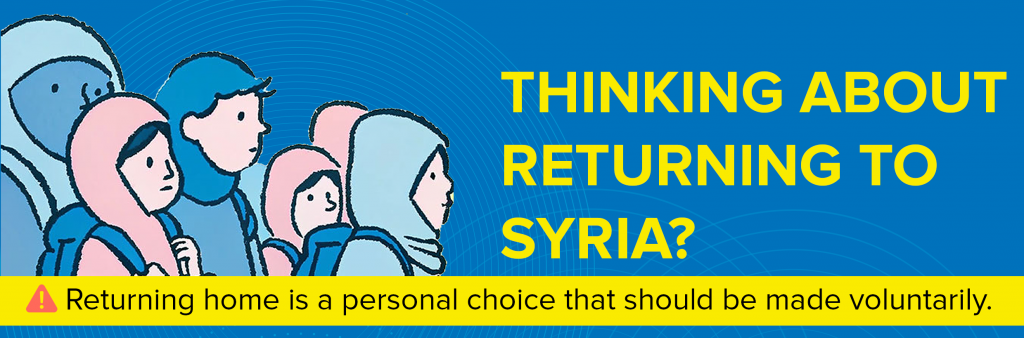
If you are a Syrian asylum-seeker or refugee, or a Palestinian refugee from Syria, registered with UNHCR and currently living in Iraq, including the Kurdistan Region of Iraq, and you are thinking about returning to Syria voluntarily, please read this information carefully. This guide is intended to help you understand the return to Syria through UNHCR’s voluntary return process, prepare in advance, and return safely and with dignity, based on your voluntary and informed decision.
UNHCR’s Position on Return
UNHCR does not promote return to Syria and continues to advocate with the authorities not to forcibly return Syrian refugees, due to ongoing risks in many areas.
However, if you decide to return voluntarily, UNHCR will respect your decision and help you to ensure that your return is voluntary, informed, safe and dignified.
If you decide to return through UNHCR’s voluntary return process, UNHCR will issue you a Voluntary Repatriation Form (VRF). This form confirms that your return was recorded by UNHCR as voluntary and will facilitate departure procedures with authorities in Iraq. UNHCR Iraq will also inform UNHCR Syria of your return, which may allow possible follow-up and support after you arrive in Syria.
If you return without going through UNHCR’s voluntary return process, UNHCR Syria will not be informed of your return by UNHCR Iraq.
For more information on conditions in Syria, please visit: https://syriaishome.org/en/
Before you apply for voluntary return
Before requesting an appointment with UNHCR, please make sure the following points are clear.
1UNHCR registration
You and all family members returning with you should be registered with UNHCR Iraq. This is important so that your return can be properly recorded.
2Travel documents
- You must have the required travel documents for all family members.
- For travel through airports or Al-Qaim, you need a valid Syrian passport or travel document for each family member.
- For travel through Peshkhabour border crossing, you need a valid Syrian passport, travel document, or Syrian national ID for each family member.
- If you do not have a valid Syrian passport or travel document, please contact the Syrian Embassy in Baghdad before applying for voluntary return support.
3Pending legal or documentation issues
- Please try to resolve any pending legal or documentation issues before you return.
- If your child was born in Iraq and does not have a birth certificate, please contact the UNHCR Iraq Helpline: 0662 330 304.
- If you have unresolved legal issues, such as child custody or a pending divorce, please contact UNHCR’s legal partners:
- For Duhok, contact Harikar:
Korek: 07507336297
Asiacell: 07736971124 - For all other governorates in Iraq, including the Kurdistan Region, contact INTERSOS: 80010222
- If only one parent is returning with a child, UNHCR may need to review the custody arrangement and obtain written consent from the parent who is not travelling.
4Specific needs
If you or any family member has a specific need, please inform UNHCR during your counselling appointment.
How to return voluntarily to Syria through UNHCR
1Step 1: Request an appointment with UNHCR
- UNHCR will contact you and schedule an appointment at a UNHCR centre in Baghdad, Erbil, Duhok, or Sulaymaniyah, depending on your location.
- Please wait to be contacted by UNHCR.
2Step 2: Attend your UNHCR appointment
Please bring:
- Your personal identification documents, such as passport, travel document, or any other identity document.
- Your UNHCR certificate.
- All family members who are returning with you.
During the appointment, UNHCR will:
- Verify your identity and family composition.
- Collect information about you and your family members.
- Provide counselling to make sure your decision is voluntary and informed.
- Provide information about possible support in Iraq and Syria.
- Give you the opportunity to ask questions or raise concerns.
- Issue your Voluntary Repatriation Form (VRF).
For families with children, UNHCR will check that children are not separated from their parents or caregivers. If a child is returning without both parents, or if a child will remain in Iraq while other family members return, further assessment may be required to protect the child’s best interests.
3Step 3: Complete the required steps with the authorities
After your UNHCR appointment, you will be guided on the next steps with the relevant authorities, depending on where you live.
- If you live in Centre and South Iraq, including Mosul and Kirkuk, you will be advised to go to the Baghdad Directorate of Residency Affairs, located in Al-Amiriya area, Mudheef Street, next to Al-Amiriya Local Council, on the following Sunday.
At the Directorate, please approach the UNHCR staff present on-site. They will guide you on the required steps with PC-MoI and the Residency Directorate.
As part of the process, PC-MoI will:
- Conduct biometric verification.
- Issue a Non-Objection Letter if you are registered in the PC-MoI registration database.
- Deregister you and collect your PC-MoI card.
The Baghdad Directorate of Residency Affairs will then:
- Verify your residency status.
- Apply a reduced overstay fine, with a maximum of 100,000 IQD, if you overstayed and are not registered with PC-MoI.
- Issue an Exit Permit valid for 10 days.
- Retrieve your residency card or documentation.
Additional fees may be required for the electronic application process.
- If you live in Erbil, Duhok, or Sulaymaniyah, after completing the UNHCR process, please go to the relevant Residency Office to complete the required steps with the Residency Directorate on the following Sunday or Monday.
The Residency Directorate in Erbil, Duhok or Sulaymaniyah will:
Additional fees may be charged as application fees for the exit permit.
Verify your residency status.
Apply an overstay fine, with a maximum of 500,000 IQD for PIC holders, if you overstayed.
Issue an exit permit or exit letter valid for 7 to 10 days.
Retrieve your residency documentation.
4Step 4: Final validation by UNHCR
- UNHCR will review your file and confirm whether all required steps have been completed.
- Once completed, your Voluntary Repatriation Form (VRF) will be stamped.
- After this, you will be cleared to travel.
5Step 5: Organize your travel
- You must depart Iraq within the validity period of your exit permit
- If your exit permit has been issued in Baghdad, you may travel through:
- Al-Qaim border crossing
- Al-Waleed border crossing
- Rabiaa border crossing
- Baghdad International Airport
- If your exit permit has been issued in Sulaymaniyah, Erbil or Dohuk, you may travel through:
- Peshkharbour Border Crossing Point
- Erbil International Airport
6Step 6: At the border
- At the border, present your Voluntary Repatriation Form (VRF) and your travel documents.
- The Residency Office will verify your documents.
7Step 7: UNHCR case closure in Iraq
After your departure, UNHCR will close your case file in Iraq. It is important to note that after processing your permanent departure to Syria, and in the event, you decided to return to Iraq and reactivate your asylum records, authorities may not allow you to re-enter and reactivate your asylum records.
One-off cash support for voluntary return
If you return through UNHCR’s voluntary return process and meet the eligibility criteria, you may receive a one-off cash grant of 130,000 IQD per person to support your return. Vulnerable families may receive additional assistance
You may be eligible if:
- You have been registered with UNHCR Iraq for at least 6 months, excluding newborns.
- You have not previously received this one-off cash assistance for return.
- You have not recently permanently returned to Syria .
If you do not meet these criteria, you can still go through the voluntary return process. However, you will not be eligible for the one-off cash grant in Iraq. You may still be considered for possible support in Syria.
How to receive the return cash assistance:
After UNHCR validates your VRF, you will receive an SMS within 3 days with details about the cash assistance. Please read the SMS carefully. It will include:
- The name of the cash collector.
- The amount of assistance.
- The suggested Zain Cash agent location.
- The deadline to collect the assistance.
The person named in the SMS must visit the Zain Cash agent before the deadline.
At the Zain Cash agent:
- Show the SMS.
- Ask the agent to scan your IRIS.
- Always ask to see the IRIS scan result.
You may cash out at one of the Zain Cash agents shared with you during UNHCR counselling. The SMS suggests the nearest agent for your convenience.
If you face any issue, please call the UNHCR Iraq Helpline: 0662 330 304.
Cash assistance is free. Zain Cash agents must not charge you any fees. UNHCR covers the service costs.
After you arrive in Syria
If you returned through UNHCR’s voluntary return process and shared your WhatsApp number, UNHCR Syria or its partners may contact you for follow-up after your arrival.
Final Reminders
- Your return is voluntary. You can change your mind at any time before departure.
- If you change your mind, please inform UNHCR immediately by calling the UNHCR Iraq Helpline: 0662 330 304.
- Once an exit permit is issued, the authorities may not reissue you with a residence permit.
- After permanent departure, the authorities may not allow you to re-enter Iraq or reactivate your asylum records.
- UNHCR’s official process is the only way to receive a Voluntary Repatriation Form (VRF).
- The Voluntary Repatriation Form is an important document after your return.
- For legal support, including custody-related issues, please contact UNHCR’s legal partners.
- Please provide a working WhatsApp number so UNHCR or partners can contact you if needed.
Report fraud, corruption, or abuse
All UNHCR services are free of charge.
If anyone asks you for money or offers to speed up your return process in exchange for payment, please report it.
You can report fraud, corruption, or abuse through:
UNHCR Iraq Helpline: 0662 330 304
Email: [email protected]
Inspector General’s Office online complaint form:Online Complaint Form | UNHCR