
In this section you will find information about:
- Fraud, Corruption and Misconduct
- Reporting Fraud, Corruption or Misconduct by Refugees and Asylum-seekers
- Reporting Fraud, Corruption and by UNHCR / Partner Organisation
- Sexual Exploitation and Abuse
- Reporting Sexual Exploitation or Abuse
- How UNHCR Protects and Uses Your Personal Data
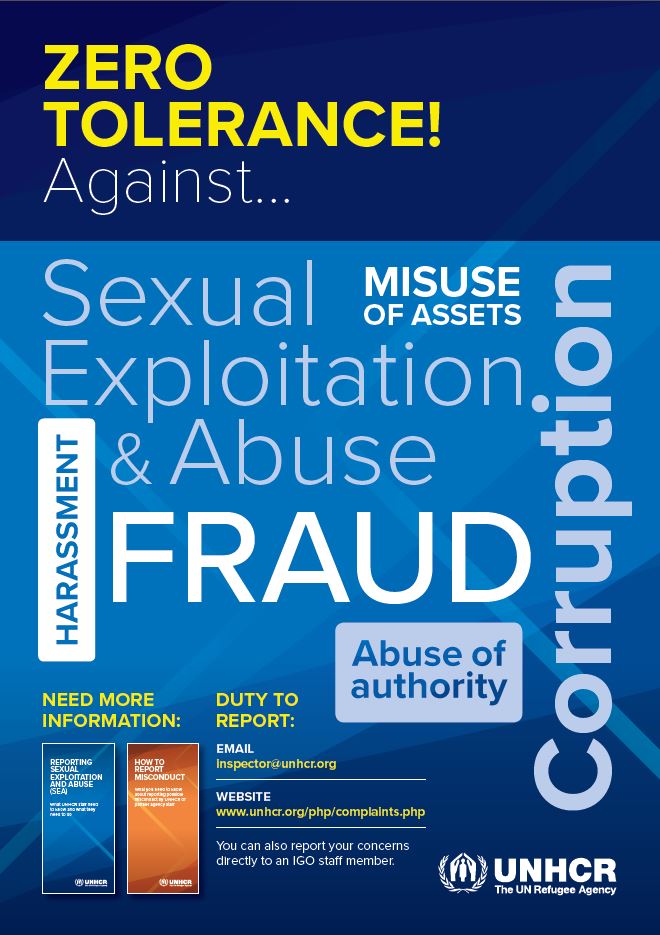
Fraud, Corruption or Misconduct
WHAT IS FRAUD?
Any act or omission, including misrepresentation or concealment of a material fact, that knowingly or intentionally misleads, or attempts to mislead, a party to obtain a benefit, whether directly or indirectly, whether for oneself or for a third party.
WHAT IS CORRUPTION?
It is offering, giving, receiving, or soliciting (directly or indirectly) anything of value to influence improperly the actions of another party.
WHAT IS MISCONDUCT?
All staff members of UNHCR, partner and/or service providers are required to comply with United Nations Staff Rules and Regulations and the UNHCR Code of Conduct. Misconduct is defined as the failure by a staff member to abide by these rules and regulations. Misconduct can be classified into various types:
- Embezzlement and procurement fraud;
- Financial negligence resulting in substantial losses;
- Sexual exploitation and abuse;
- Harassment (including mobbing);
- Assault, threats or retaliation;
- Unlawful acts (e.g. theft or fraud) on or off UN premises;
- Misrepresentation or false certification relating to a claim or benefit;
- Misuse of the Organization’s equipment or assets;
- Abuse of authority;
- Non-compliance with local laws or the staff’s personal legal obligations.
REMEMBER:
ALL SERVICES ARE FREE: All services provided by UNHCR and its partners are provided free of charge. No refugee or asylum-seeker should be asked to pay for any services that UNHCR provides. Do not trust anyone or any organization asking you to pay money. You cannot pay to receive quicker services from UNHCR or its partners.
- If money or any other form of favour, including of a sexual nature, is requested from you in exchange for UNHCR services, do not believe them and report it to UNHCR immediately.
- These persons will be subject to disciplinary action which, in the case of UNHCR or partner staff, includes termination of employment and referral to the Government authorities for possible criminal investigation.
ASCERTAIN IDENTITY AND PURPOSE BEFORE SHARING YOUR PERSONAL DATA: Ask UNHCR/Partner staff member to ascertain their identity and purposes before sharing your personal data and documentation, including passport, national identity documents, or documents you receive from UNHCR. Do not share your personal data with anyone suspicious.
FRAUD, CORRUPTION AND EXPLOITATION AFFECTS EVERYONE: Fraud, corruption and exploitation whether committed by UNHCR/partner officials or asylum-seekers/refugees can have a significant impact on availability of services provided by UNHCR and partners and result in significant delays in finding appropriate solutions. If you suspect any such act, report it.
REPORTING FRAUD, CORRUPTION OR MISCONDUCT
REPORT FRAUD BY REFUGEES AND ASYLUM-SEEKERS
You should report any fraud or corruption by refugees and asylum-seekers that you observe through the complaints mechanisms mentioned below. All reports will be processed in a confidential manner.
Email: [email protected]
Letter: P.O. Box 25577, 1310 Nicosia, Cyprus
Phone: +357 22 359043
Complaints / Suggestions boxes: available at the offices of UNHCR staff stationed at the Kofinou Reception Centre and the Pournara First Reception Centre, and at UNHCR’s Partner NGO offices.
Your complaint will be handled in accordance with defined procedures according to the nature of your complaint. All complaints are treated confidentially for your own protection. In making your complaint, provide all information that you believe is relevant. Anonymous complaints will be considered, but it may be difficult to efficiently address your concern if we cannot contact you.
REPORT FRAUD, CORRUPTION AND EXPLOITATION BY UNHCR / PARTNER ORGANIZATION
You should report any fraud, corruption or exploitation, and misconduct by UNHCR and partners that you observe. We have robust procedures to prevent fraud and corruption and to investigate and take action against fraudulent and corrupt persons.
If you wish to report improper conduct (including corruption, fraud, bribery, exploitation, extortion etc) by UNHCR or other official, contact:
Email: [email protected]
Online complaint form: www.unhcr.org/php/complaints.php
In person or by post: 94, rue de Montbrillant, Case postale 2500, 1211 Geneva, Switzerland
Mark all mail as CONFIDENTIAL.
Do not put yourself in danger by trying to do your own investigations. Reporting fraud and corruption is an obligation for all refugees and asylum-seekers and will not result in you receiving any direct reward or special treatment.
Strict confidentiality standards as well as other standards and procedural safeguards apply to investigations conducted by the Inspector General’s Office (IGO). The IGO safeguards the confidentiality of the identity of the person from whom or the entity from which it receives a report of possible improper conduct.
WHAT TO INCLUDE WHEN REPORTING TO THE IGO?
- What happened?
Describe in detail what you know about the incident or incidents.
- Who committed the alleged wrongdoing?
Do you know if anyone else was involved?
Please provide full names, job titles and organization, if possible.
- When and where did the incident or incidents occur?
Please include dates and times, if possible.
YOUR RESPONSIBILITIES AS BENEFICIARY:
DO NOT ATTEMPT TO BRIBE AN OFFICIAL: Bribing any person for any services provided by UNHCR or its partners is prohibited. If you attempt so, you may face consequences that include denial of services and, possibly, criminal investigation.
ALWAYS TELL THE TRUTH: Knowingly telling UNHCR and partners incorrect or incomplete information in order to receive assistance or services, may be considered fraud and may lead to negative consequences for you including a denial of services or protection and possibly criminal investigation. If you have previously made false statements, you should alert a staff member as soon as possible and explain the circumstances fully.
How to report sexual exploitation and abuse by a UNHCR, UN or NGO staff member?
Sexual exploitation and abuse against refugees, asylum seekers and stateless people is considered unacceptable behaviour and it is prohibited for all United Nations and NGO partner staff members.
What is sexual exploitation?
It is any actual or attempted abuse of a position of vulnerability, differential power, or trust, for sexual purposes. It includes trafficking and prostitution.
What is sexual abuse?
It is any actual or threatened physical intrusion of a sexual nature, whether by force, or under unequal or coercive conditions. It includes sexual slavery, pornography, child abuse and sexual assault.
In line with the United Nations standards of conduct, the staff members of UNHCR and NGO partners must not:
- Have sexual activity with anyone in exchange for money, employment, preferential treatment, goods or services
- Have sexual activity with any person under the age of 18 years (regardless of the local age of consent or majority)
- Engage in any other form of sexually humiliating, degrading or exploitative behaviour.
If you are aware of, or have concerns or suspicions about a possible case of sexual exploitation and abuse by a UNHCR, UN or NGO staff member, please report this directly to the Inspector General’s Office (IGO) at UNHCR Headquarters:
- Email: [email protected]
- Confidential fax: +41 22 739 7380
- Mail: UNHCR, 94 Rue de Montbrillant, 1202 Geneva, Switzerland
In your report, you should include:
- What happened? Describe in detail what you know about the incident or incidents.
- Who committed the alleged wrongdoing? Do you know if anyone else was involved? Please provide full names, job titles and organization, if possible.
- When and where did the incident or incidents occur? Please include dates and times, if possible.
Your report will be treated with discretion and kept strictly confidential.
Your Personal Data: How UNHCR Protects and Uses It
Why do we process your personal data?
UNHCR is an agency of the United Nations whose mandate is to protect and find durable solution for refugees. More specifically, UNHCR in Cyprus and our partner NGOs provide protection services and assistance to asylum-seekers and refugees, which include legal counselling, legal assistance, social case management, material assistance etc. The type of assistance you may receive depends on your personal situation and needs. In order to provide you with the necessary assistance, UNHCR will need to collect and process your personal data.
How do we process your personal data?
In accordance with our General Policy on the Protection of Personal Data and Privacy (2022) and the Policy on the Protection of Personal Data of Persons of Concern to UNHCR (2015), UNCHR will collect, record and process your personal data only for a specific purpose in line with our mandate (e.g. to provide you with assistance, ensuring UNHCR’s accountability and archiving) and if we have a legitimate basis to do so or based on your consent.
The personal data we collect from you is retained only as long as necessary, with exceptions for archiving, research, accountability, and long-term protection.
UNHCR will not share your personal data with authorities of your country of origin. However, if it is relevant to your situation, your personal data may be shared with our partner NGO and/or the relevant government authorities to advocate for your rights and access to essential services in Cyprus. In this case, information we share will be strictly limited to what is necessary for extension of services and will not be shared further. UNHCR will inform you if your personal data is shared with any of these third parties, the reason for the data sharing and what you can reasonably expect UNCHR to do in your case.
NGO Partners are bound by local data protection laws and are required to offer the same level of data protection as UNHCR’s Data Protection Policies. Thus, your personal data will remain protected and treated with confidentiality.
It is important that you provide accurate and complete information. You may also need to keep UNHCR informed of changes to your personal situation (e.g. family composition) if it affects your rights and access to our services. If you refuse or fail to provide the requested personal data or information, UNHCR and/or Partner NGO may not be able to assist you.
UNHCR will store and process your personal data in a secure manner to ensure confidentiality. We also make sure that your personal data is only accessible to UNHCR staff who need to know it for a specific purpose linked to your case.
What are your rights?
You have the right to be informed by UNHCR about the following: (i) what data we have about you; (ii) how your data is used; (iii) which Partner, if any, processes your personal data on behalf of UNHCR; (iv) where your data is stored; (v) which data may be shared with others and with whom.
You can request a confirmation from UNHCR of the personal data that we hold about you, and the absence thereof, and to obtain a copy of your personal data being processed by UNHCR. You have the right to object to UNHCR’s processing of your data because of your specific situation.
You also have the right to request for correction of any incorrect, inaccurate or incomplete data about you, and request for deletion of your personal data if you believe that UNHCR no longer have any purpose or legitimate basis to keep it.
Should you have any concerns or complaints regarding the processing of your personal data by UNHCR, you may lodge a complaint with us.
To exercise these rights, you can contact UNHCR Cyprus by using the form on our website, calling us at 22 359043, or emailing us at [email protected].