
All services by UNHCR, RRS and partners are free of charge
What is Fayda?
The Fayda number is a 12-digit unique identification number issued by the National ID program (NIDP) to all residents of Ethiopia. This number is utilized to identify each individual through the use of biometric technology. The Government of Ethiopia aims to digitize and centralize the system, implementing the “one person, one identity” rule so that it has been rolled out the Fayda system for all residents of Ethiopia, irrespective of their status.
NIDP, RRS, and UNHCR are collaboratively working to integrate refugees and asylum seekers into this program. This integration involves incorporating the Fayda number into the ID cards of refugees and asylum seekers. A legal data-sharing agreement has been signed between UNHCR, RRS, and NIDP, ensuring the shared data’s security and regulated usage.
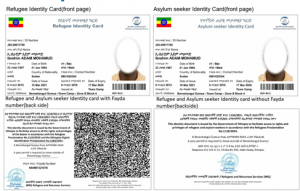
Image: Fictitious personal data comparing the refugee and asylum-seeker identity cards with and without Fayda number and QR code (image does not enlarge).
See more information on the integration of refugees to the Fayda Digital ID Project in the below FAQ.
Which information will be used for the FAYDA enrollment?
RRS and UNHCR will share ONLY the following information to generate your Fayda number:
- Biometrics:
- 10 fingerprints
- Iris (two eyes)
- Face photo
- Full Name
- Sex
- Date of Birth (Age)
- Address
- Nationality
Who is eligible for a Fayda number?
- All registered refugees and asylum seekers aged 5 years and above, in camps and urban settings in Ethiopia.
- A Fayda number will be issued to anyone willing to have one.
What are the benefits of having a Fayda number?
It provides greater security and protection, reduces identity theft, minimizes detention risk, and enables access to basic services like Ethiopian nationals:
- Opening bank accounts
- Purchasing SIM cards
- Accessing education
- Visiting health centers
- Obtaining a TIN number
- And more…
What is the registration process?
- Submit your request flagged under “Refugee or asylum seeker ID card with Fayda number” through DRCS.
- Attend an information briefing on NIDP inclusion.
- Provide your consent if you agree to be included in the program.
- Your data will be shared with NIDP for Fayda number and QR code generation.
- Receive your Fayda number and QR code from NIDP.
- Issuance of Refugee ID card with Fayda number and QR code.
What happens if I was previously registered with NIDP?
- Inform RRS and UNHCR before requesting a new ID card with Fayda.
- RRS and UNHCR will inform NIDP and request deactivation of your previous record.
- RRS will issue your new refugee ID card with Fayda number and QR code.
What happens if I do NOT agree to be included in NIDP?
- Inform RRS and UNHCR before requesting an ID card through DRCS.
- You will be issued a refugee ID card without Fayda number and QR code.
Important: Currently, the Government of Ethiopia and private services require a Fayda number in all basic services. You can change your mind later and consent to receive an ID card with Fayda.
Protection from Fraud and Sexual Exploitation, Abuse and Gender-Based Violence
Refrain from interacting with individuals who claim they can provide you with a refugee ID card containing a Fayda number outside the RRS compound. Such actions would be considered fraudulent because it won’t include all your information in the system. RRS is the only organization authorized by NIDP to issue refugee ID cards with Fayda numbers. Do not allow yourself to be misled or exploited, as all our services are provided free of charge.
If you encounter any fraud and sexual and gender-based violence, regarding any service provision whether by staff, Community representatives, and Refugee outreach volunteers (ROV’s) kindly report using the below communication channels:
➢ Digital request and compliant system (DRCS) https://drcs.rrs-eth.org and https://drcs.rrs-eth.org
➢ Suggestion box placed at the reception center
➢ UNHCR Protection/Registration staff available at the reception center
➢ In case of fraud allegations against UNHCR staff member, you can report to UNHCR’s inspector General’s Office (IGO) by email at [email protected] or by online compliant form https://www.unhcr.org/igo-compliants.html
How do I request an ID card with a Fayda number?
- Submit your request using DRCS via the following link https://drcs.unhcr-eth.org/service/create , using your smart phones.
- Request the Help Desk operators located at OSS center who are designated by RRS and UNHCR to submit the ticket on behalf of the refugees.
What is the Fayda Digital ID inclusion project?
This project is implemented jointly by the United Nations High Commissioner for Refugees (UNHCR) and the Refugees and Returnees Service (RRS). UNHCR and RRS work together in Ethiopia to provide humanitarian assistance to refugees and asylum-seekers and to coordinate the delivery of assistance between multiple non-governmental organizations and service providers.
UNHCR and RRS aim to additionally facilitate the enrolment of refugees and asylum-seekers in the national digital identity system of Ethiopia by sharing your personal data with the National Digital Identity Program (NIDP) for the reasons explained below.
The National ID Program is a program established under the Prime Minister’s Office in 2021 to ensure a reliable, and forward-looking digital identification platform for all residents in Ethiopia. The enrolment in NIDP system is voluntary, yet it is likely to become mandatory at service point.
Why do we share your personal data?
The personal data already registered in UNHCR and RRS system will be shared with NIDP to enable UNHCR and RRS to pursue their mandate of protection for refugees and asylum-seekers. Our mandate includes ensuring that you are included in the national digital identity system for a facilitated access to private and public sector service providers as this will help you to have access to services such as financial services, tele-communication services, and achieve a better level of self-reliance.
This process is separate from the process of data collection by UNHCR and RRS for purposes outside the enrolment in the national digital identity system.
NIDP uses the information shared by UNHCR and RRS to enable public and private sector service providers to digitally authenticate your individual identity with the aim of service provision. Subject to your consent NIDP shares this data with public and private sector service providers ONLY when you approach these providers. The service providers have the legal obligation to use the data ONLY for the aim of authenticating your identity and consequently providing you with services.
What type of personal data do we need and how are we going to use it?
RRS/UNHCR will share personal data about you with NIDP, including your
- Biographical data (full name, date of birth, sex, nationality, proGres ID, BIMS ID)
- Photo, iris and fingerprints for identification and authentication purposes,
- Contact information (such as address and phone number) to be able to contact you and deliver services. The phone number is not necessary to be included, yet if shared it could enable service providers to better reach you and enable access to services.
- An official letter as Proof of Consent and Proof of Identity on behalf of you
NIDP will consequently share with RRS/ UNHCR Fayda Identification Number (FIN) and QR code which will be printed on your refugee/asylum-seeker ID.
Your personal data will be kept for as long as required to facilitate your enrolment in the national digital identity system in Ethiopia.
Who will have access to your data?
Where it is necessary to provide public and private sector services, your personal and biometric data, may be shared with.
- NIDP public sector partners
- NIDP private sector partners
- Private sector authentication service providers
Under no circumstances will RRS, UNHCR or NIDP share your personal data with the government of your country of origin or any other entity other than those indicated above without your consent.
What do you need to further know?
We will seek to provide you with relevant assistance on the basis of the information you provide us. Therefore, it is important to provide accurate data. If the information that you provide is not accurate to the best of your knowledge; in addition to legal liability, your access to assistance and services may be negatively impacted and even stopped.
What are your rights?
You have the right to access your personal data and to relevant information concerning how we use it. You have the right to correct or update your personal data. You also have the right to ask that we do not share your personal data with NIDP. You have the right to object to our use of your personal data at any time. Please note that you can exercise your rights by contacting us through the channels provided below and also by approaching enrollment staff with questions. Please note that your personal data is necessary for enrolment in the national digital identity system and for the facilitation of access to public and private services. If you decide to opt out from the enrolment exercise or to object to the continued use of your personal data, you will still receive your RRS/UNHCR refugee ID card/asylum-seeker document and will be able to benefit from regular assistance provided to refugees and asylum-seekers through RRS/UNHCR. However, you will not benefit from public and private sector services provided through the NIDP enrolment such as financial and social services of public and private sector service providers in the country.
How can you contact us?
If you have questions about how we process your personal data, or if you would like to make a request or lodge a complaint about our use of your personal data you can do so by
● Approaching enrollment staff during the enrollment interview
● Putting a complaint on the Digital Request and Complaint System (DRCS) Link: Home – Digital Request and Complaint System
● Also, you can use NIDP communication channels and grievance redressal mechanisms.
